
Layers of the Earth Diagram
If you could dig straight down, you would pass through the thin rocky crust, thousands of kilometres of hot, slowly flowing mantle, a liquid iron outer core and finally a solid iron inner core hotter than the surface of the Sun. This interactive diagram shows each layer; click one to learn about it, drag the depth probe to any depth, or switch to true scale to see how thin the crust really is.
- Free to use
- No sign-up
- Runs in your browser
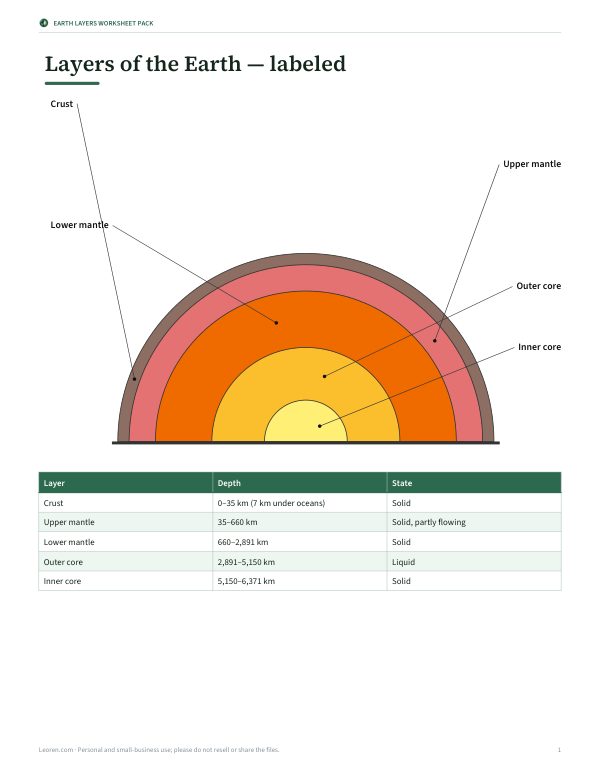
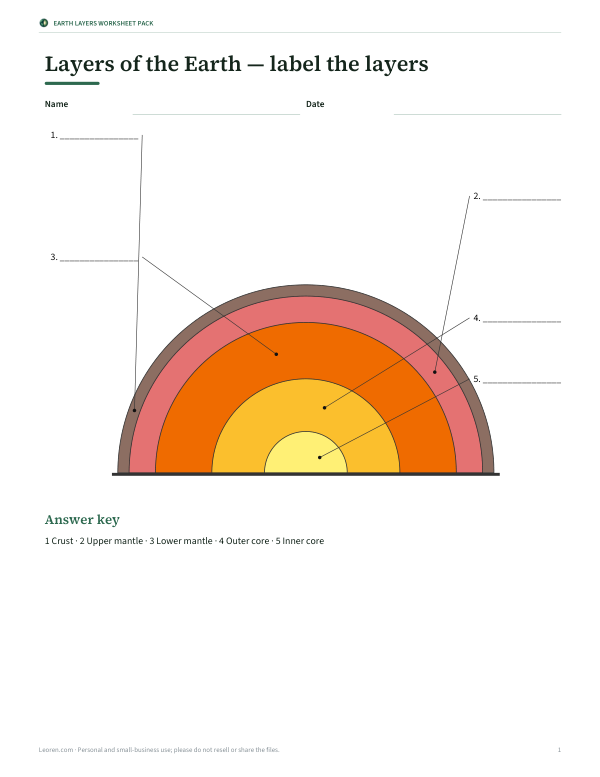
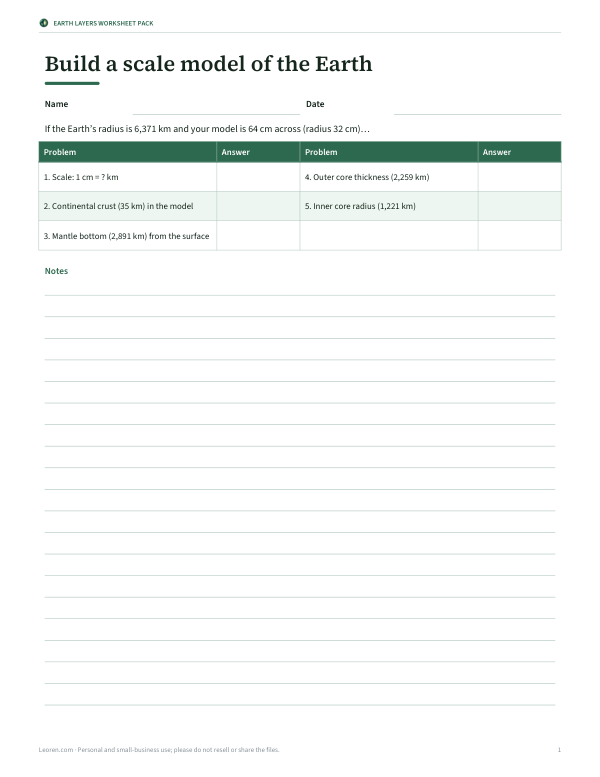
Interactive Earth layers
Earth Layers Worksheet Pack
Printable Earth science worksheets with answer keys: labeled and blank layers of the Earth diagrams, a layer fact table, a scale model activity and a 12-question quiz.
- Labeled diagram (PDF)
- Blank diagram (PDF)
- Scale model activity (PDF, DOCX)
- 12-question quiz (PDF, DOCX)
Formats: PDF, DOCX. Instant download after payment (link valid 72 hours, up to 5 downloads). AI-assisted: the templates were drafted with AI help and reviewed and laid out before publishing.
$5.00 USD, one-time 4 files · about $1.25 each
- Instant download
- 7-day refund
- Secure checkout by Stripe
7-day money-back guarantee. Full refund within 7 days of purchase, even after you download.
Free sample: Earth Layers Blank (PDF, 62 KB)
Full refund within 7 days — see the refund policy and license.
Free printables
Single sheets you can print right now, no sign-up. The full pack adds every sheet in one download plus the editable files.
 Printable Layers of the Earth Quiz
The layers at a glance
| Layer | Depth | State and composition | Temperature | Density (g/cm³) |
|---|---|---|---|---|
| Continental crust | 0 – about 35 km (up to 70 km under mountains) | Solid rock, mainly granite-like rocks rich in silicon and aluminium | up to ~500 °C at the base | 2.7 |
| Oceanic crust | 0 – about 7 km below the sea floor | Solid basalt and gabbro, denser than continental crust | up to ~500 °C | 3.0 |
| Lithosphere | 0 – about 100 km | The rigid outer shell: crust plus the uppermost mantle, broken into tectonic plates | up to ~1,300 °C at its base | — |
| Asthenosphere | about 100 – 410 km | Hot, slowly flowing solid rock in the upper mantle that plates slide over | ~1,300 – 1,500 °C | 3.4 |
| Upper mantle | Moho – 410 km (transition zone to 660 km) | Solid silicate rock (peridotite) rich in olivine | ~500 – 1,600 °C | 3.4 – 4.0 |
| Lower mantle | 660 – 2,891 km | Solid, very dense silicate rock under enormous pressure | ~1,600 – 3,700 °C | 4.4 – 5.6 |
| Outer core | 2,891 – 5,150 km | Liquid iron and nickel; its flow generates Earth’s magnetic field | ~4,000 – 5,400 °C | 9.9 – 12.2 |
| Inner core | 5,150 – 6,371 km | Solid iron–nickel ball, solid because of immense pressure | ~5,400 °C (estimates vary) | 12.8 – 13.1 |
The deep values come from seismology — the study of how earthquake waves travel through the planet — and from laboratory experiments on rocks and metals at high pressure. Published estimates vary, especially for temperatures in the core.
How scientists know what’s inside
The deepest hole ever drilled, the Kola Superdeep Borehole in Russia, reached about 12 km — less than 0.2% of the way to the centre. Everything deeper is known indirectly. Earthquake waves speed up, slow down and bend as they pass through materials of different density and stiffness. Shear waves (S-waves) cannot travel through liquid, and they disappear on the far side of the Earth from large earthquakes — the shadow zone that revealed the liquid outer core. Meteorites, which formed from the same material as the early Earth, give clues to the core’s iron–nickel composition.
Crust and lithosphere
The crust is the thin outer skin: about 7 km thick under the oceans and 30–50 km under the continents, reaching 70 km beneath high mountain ranges. The crust and the rigid top part of the mantle together form the lithosphere, which is broken into tectonic plates. These plates move a few centimetres a year over the hotter, softer asthenosphere, causing earthquakes, volcanoes and mountain building at their edges.
The mantle
The mantle makes up about 84% of Earth’s volume. It is solid rock, but over millions of years it flows like extremely thick toffee. Heat from the core and from radioactive decay drives slow convection currents in the mantle, which help move the plates above. A transition zone between about 410 and 660 km marks changes in the mineral structure as pressure increases.
The core
The core begins about 2,900 km down. The outer core is liquid iron and nickel, and its churning motion generates Earth’s magnetic field, which protects the atmosphere from the solar wind and makes compasses work. The inner core, starting about 5,150 km down, is solid despite temperatures around 5,000–6,000 °C, because the enormous pressure — over three million times atmospheric pressure — keeps the metal from melting.
How to use the interactive diagram
- Click any layer to see its depth, state, temperature and density.
- Drag the depth probe to see which layer lies at that depth, with approximate temperature and pressure.
- Switch to true scale to see how thin the crust really is compared with the rest of the planet.
- Use Numbered mode or the quiz to test yourself, and print a labeled or blank diagram.
Worked example: a journey to the centre
Set the probe to 30 km: you are still in continental crust at around 450 °C. At 100 km you reach the bottom of the lithosphere, near 1,300 °C and over 3 GPa of pressure. At 2,891 km the probe crosses into the liquid outer core, where the temperature jumps to roughly 3,700–4,000 °C and the pressure is about 136 GPa — some 1.3 million times the pressure of the air at sea level. At 6,371 km, the centre, estimates put the temperature around 5,500 °C and the pressure above 360 GPa.
Memory aid
From the outside in: Crust, Mantle, Outer core, Inner core — “Can Mice Organise Ice?” The core is about the size of Mars, the inner core about 70% of the Moon’s diameter, and the crust is thinner, relative to the Earth, than the skin of an apple.
Frequently asked questions
What are the four main layers of the Earth?
The crust, mantle, outer core and inner core.
Which layer of the Earth is liquid?
The outer core, made of liquid iron and nickel.
How thick is the Earth’s crust?
About 7 km under oceans and 30–50 km under continents.
What is the hottest layer?
The inner core, around 5,000–6,000 °C by most estimates.
Why is the inner core solid?
The immense pressure keeps the iron from melting despite the heat.
Can I print a blank diagram?
Yes, choose Numbered mode and print.
How deep is the centre of the Earth?
About 6,371 km below the surface.